

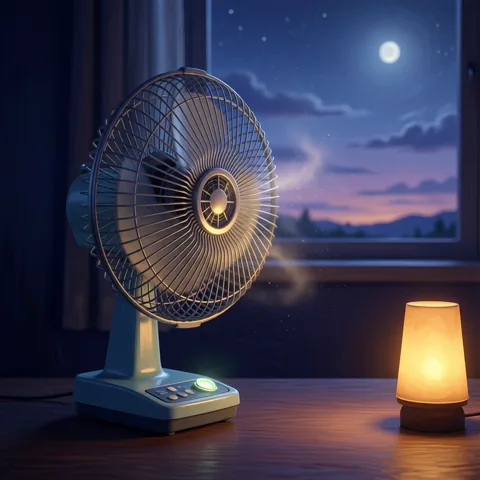
What a fan really sounds like
A fan makes two sounds. The blades passing give a low hum at a steady pitch, and the air tumbling off them gives a broad rush. That rush is close to noise, but it isn’t white: on our measurements it is strongest from about 1 to 4 kHz and falls away almost completely above 6 kHz.
White noise keeps rising all the way to the top of the range. That is the difference you hear: a fan is a soft whir, and white noise has a crisp edge a fan doesn’t.
The practical differences
A fan also moves air, which some people want and some don’t, and it can dry out eyes and sinuses over a night. It uses power, can rattle as it ages, and its sound changes with the speed setting. A recording or a generated noise stays exactly the same every night.
If you are used to a fan but don’t want the draught, a fan recording gives you the sound without the air. If you find the fan’s hum noticeable, white or pink noise has no pitch in it at all.
Measured side by side
We measured both loops exactly as they play on this page.
White noise A box fan
| White noise | A box fan | |
|---|---|---|
| Peaks around | 8 kHz | 4 kHz |
| Balance point | 5.6 kHz | 1.9 kHz |
| Moves by | 0.8 dB | 0.9 dB |
| Made | Generated | Recorded |
| In the app | Subscription | Free |
The numbers
| Octave band | White noise | A box fan |
|---|---|---|
| 63 Hz | -18.5 dB | -17.5 dB |
| 125 Hz | -14.1 dB | -3.3 dB |
| 250 Hz | -11 dB | -6.9 dB |
| 500 Hz | -8.3 dB | -10 dB |
| 1 kHz | -5.6 dB | -1 dB |
| 2 kHz | -2.9 dB | -0.4 dB |
| 4 kHz | -0.6 dB | 0 dB |
| 8 kHz | 0 dB | below −60 |
| 16 kHz | -3.9 dB | below −60 |
Which to choose
| If you want | Try | Because |
|---|---|---|
| The familiar sound of home | A box fan | A real fan, hum and all. |
| No pitch or hum at all | White noise | Pure, even noise. |
| A softer top end | A box fan | It falls away above 6 kHz. |
| Covering high, sharp sounds | White noise | Strong all the way up. |
Or play them together in the mixer.
Questions
Is a fan the same as white noise?
Not exactly. A fan makes a broad rush of air that is similar to noise, plus a low hum from the blades. Measured, it has much less energy at the very top than white noise, which is why it sounds softer.
All night, with the screen off. A browser tab stops when your phone locks. In Lalai the sound keeps playing, fades out on a timer, and you can layer up to five of 198 sounds with music underneath. The mixer, the timer and a free sound in every category are free for good.

Listening safely
Start with your volume low, keep the phone off the pillow, and let the timer fade the sound out. Our listening notes say more.
Lalai is for relaxation and enjoyment. We don’t claim that this or any sound changes how you sleep, and if poor sleep goes on for weeks, please see a doctor. More on protecting your hearing.
More comparisons
- Brown noise vs white noise
- Pink noise vs white noise
- Pink noise vs brown noise
- Green noise vs pink noise
- Rain sounds vs ocean sounds
See every noise colour in the colours of noise, or browse all 50 night sounds.