About the recording
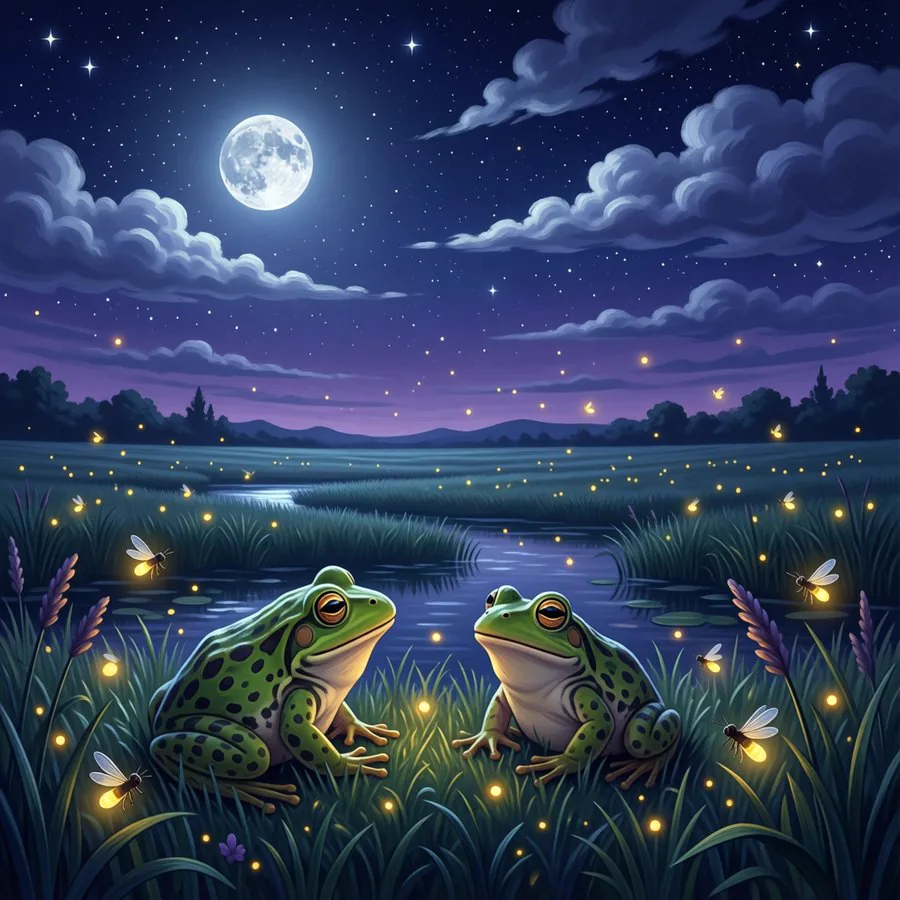
Felix Blume recorded toads and frogs at night in the desert in San Luis Potosí. The calls are concentrated around 1 kHz, with very little above or below, which gives the chorus its rounded, pulsing sound.
It is steady overall, moving by about a decibel, because there are so many callers that the gaps between one frog’s calls are filled by another’s.
| Recorded by | felix.blume on Freesound, “Toads and frogs during the night in the desert (San Luis Potosi, Mexico)” |
|---|---|
| Licence | CC0, a public-domain dedication |
| Here | A 60-second loop, crossfaded so it turns without a seam |
| In Lalai | The full 10-minute recording, with a subscription |
Why frogs sing in chorus
Almost all frog calls are made by males, calling for mates. A frog pushes air from its lungs over its vocal cords and into a vocal sac, a balloon of skin under the chin or at the sides of the head, which swells and works as a resonator to make the call louder.
Desert frogs and toads spend most of the year buried underground and emerge after heavy rain, when temporary pools appear. They have only days to breed, so they all call at once, and the chorus can be very loud.
In a chorus, many species time their calls to avoid overlapping their neighbours, leaving small gaps to fill. From a distance, all that careful timing blends into one continuous sound.
Measured
We measured the loop on this page. Its energy peaks in the octave around 1 kHz, and its spectral centroid, the balance point of all its energy, is 1.3 kHz: brighter than 21 of the other 49 sounds on this site. Between its quieter and louder moments there are about 1 decibels, so it is very steady, and it is steadier than 30 of the others.
The numbers
| Octave band | A frog marsh |
|---|---|
| 63 Hz | -42.4 dB |
| 125 Hz | -44.1 dB |
| 250 Hz | -40.3 dB |
| 500 Hz | -17.5 dB |
| 1 kHz | 0 dB |
| 2 kHz | -6.6 dB |
| 4 kHz | -37.1 dB |
| 8 kHz | -50.9 dB |
| 16 kHz | below −60 |
Closest in shape on this site: gentle surf, summer meadow and rain on a tin roof.
Pair it with
In the app you can layer up to five sounds and set each one’s level, and on this site the mixer does the same with up to five of these. These go well with a frog marsh:
- Lake shore. Small waves on the shore of the pond.
- Night drizzle. The rain that brought them out.
- Crickets. Crickets in the grass nearby.
Ready-made mixes with it: riverbank at 2am.
From the journal
All night, with the screen off
A browser tab usually stops playing when your phone locks or the tab goes to sleep. In the Lalai app, the full 10-minute recording keeps playing with the screen off and fades out on the timer. You can layer up to five sounds, put slow original music underneath, and keep everything on your phone for nights with no signal.
Free to try for seven nights. A frog marsh comes with a subscription, $24 a year or $3 a month, and new subscribers get seven nights free. The mixer, the timer and a free sound in every category are free for good. No ads, no account, no analytics.

Listening safely
Start with your volume low, keep the phone off the pillow, and let the timer fade the sound out. Our listening notes say more.
Lalai is for relaxation and enjoyment. We don’t claim that this or any sound changes how you sleep, and if poor sleep goes on for weeks, please see a doctor. More on protecting your hearing.
More night nature sounds
All 8 night nature sounds compared, and in spring sounds. Or browse all 50 night sounds.