
About the recording
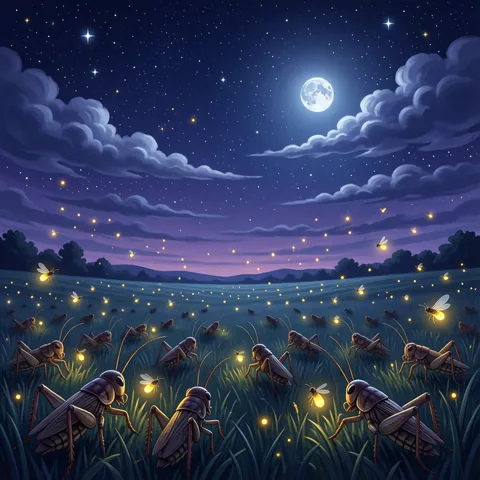
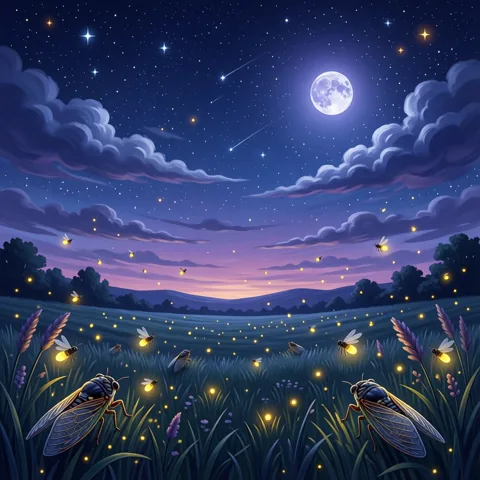
Felix Blume recorded it in Sian Ka’an, a protected stretch of forest, wetland and coast on the Yucatán peninsula. The insect chorus is dense and continuous.
It is the highest-pitched recording on the site. Its energy peaks in the top octave we measure, around 16 kHz, where many insects sing. If it sounds thin on a phone speaker, that is why: small speakers and older ears both lose the very top.
| Recorded by | felix.blume on Freesound, “Forest at night, crickets, cicadas and insects in the Sian Ka'an Biosphere Reserve” |
|---|---|
| Licence | CC0, a public-domain dedication |
| Here | A 60-second loop, crossfaded so it turns without a seam |
| In Lalai | The full 5-minute recording, with a subscription |
Why a forest gets louder at night
Many forest insects call at night, when it is cooler and damper and fewer predators hunt by sight. Crickets, katydids and some cicadas all sing by rubbing or clicking parts of their bodies, and in a warm tropical forest there are enough of them to make a continuous wall of sound.
Each species tends to keep to its own range of pitches and its own rhythm. Ecologists call it the acoustic niche hypothesis: animals that share a habitat spread out across the spectrum so they can still hear their own kind.
Much of an insect chorus is pitched very high, above 10 kHz, higher than most birdsong and right at the edge of adult hearing. Children hear more of it than their parents do.
Measured
We measured the loop on this page. Its energy peaks in the octave around 16 kHz, and its spectral centroid, the balance point of all its energy, is 13.9 kHz: brighter than 49 of the other 49 sounds on this site. Between its quieter and louder moments there are about 1.4 decibels, so it is very steady, and it is steadier than 22 of the others.
The numbers
| Octave band | Forest at night |
|---|---|
| 63 Hz | -44.9 dB |
| 125 Hz | -45 dB |
| 250 Hz | -44.2 dB |
| 500 Hz | -41.9 dB |
| 1 kHz | -43.7 dB |
| 2 kHz | -32.9 dB |
| 4 kHz | -11.7 dB |
| 8 kHz | -15.3 dB |
| 16 kHz | 0 dB |
Closest in shape on this site: violet noise, birdsong, far off and cicadas.
Pair it with
In the app you can layer up to five sounds and set each one’s level, and on this site the mixer does the same with up to five of these. These go well with forest at night:
- Rain in the jungle. The same kind of forest in the rain.
- A frog marsh. Frogs calling from the wetland nearby.
- Brown noise. A deep bed under the insects balances the high end.
In Lalai’s sleep stories
Lalai’s hour-long stories have their own sounds under the voice. You’ll hear this kind of sound in:
- Caravanserai on the Salt Road: the warm night insects of the dry country
From the journal
All night, with the screen off
A browser tab usually stops playing when your phone locks or the tab goes to sleep. In the Lalai app, the full 5-minute recording keeps playing with the screen off and fades out on the timer. You can layer up to five sounds, put slow original music underneath, and keep everything on your phone for nights with no signal.
Free to try for seven nights. Forest at night comes with a subscription, $24 a year or $3 a month, and new subscribers get seven nights free. The mixer, the timer and a free sound in every category are free for good. No ads, no account, no analytics.

Listening safely
Start with your volume low, keep the phone off the pillow, and let the timer fade the sound out. Our listening notes say more.
Lalai is for relaxation and enjoyment. We don’t claim that this or any sound changes how you sleep, and if poor sleep goes on for weeks, please see a doctor. More on protecting your hearing.
More night nature sounds
All 8 night nature sounds compared. Or browse all 50 night sounds.