About the recording
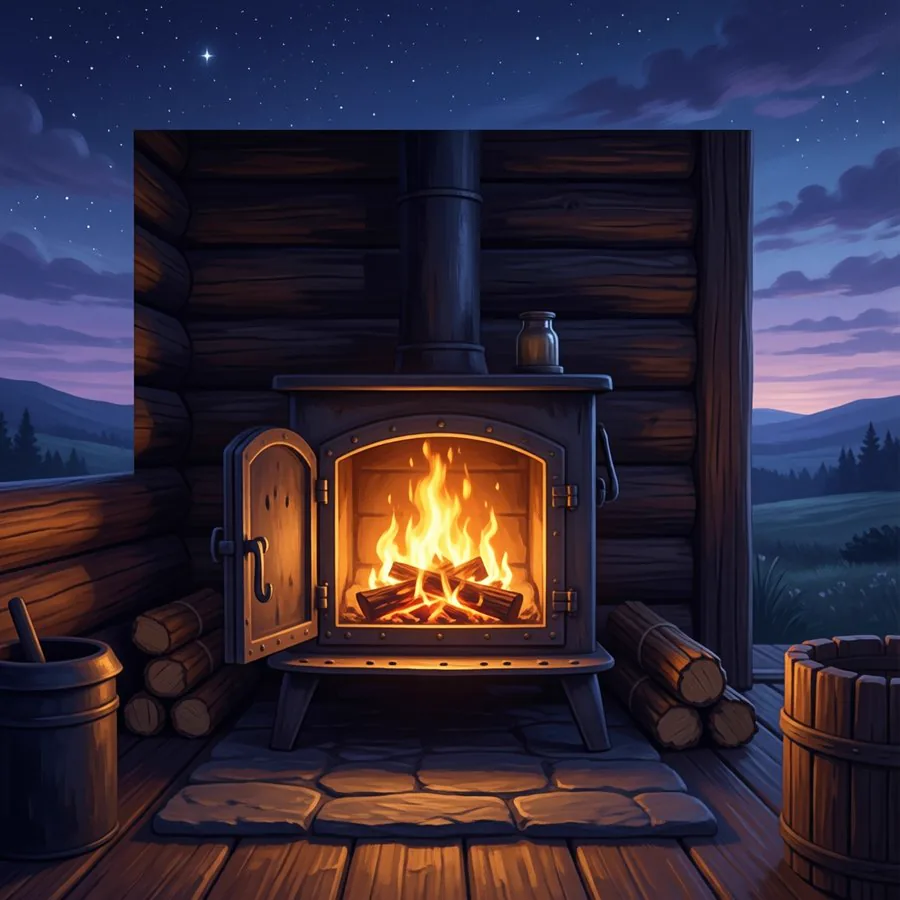
TapikkaFin recorded a wood-burning stove being used: the fire, the stove door, and a cast-iron pan on top. You may catch the odd metallic knock in the loop, which is the stove being lived with.
It is one of the deepest fire sounds here, with its energy right at the bottom, around 63 Hz, and a steady level that moves by under two decibels.
| Recorded by | tapikkaFin on Freesound, “Wood burning stove, operating the stove, cast iron pan, steel spatula” |
|---|---|
| Licence | CC0, a public-domain dedication |
| Here | A 60-second loop, crossfaded so it turns without a seam |
| In Lalai | The full 5½-minute recording, with a subscription |
Why a stove sounds lower than an open fire
A stove encloses the fire in heavy iron or steel. Metal that thick blocks the high, sharp part of the crackle and lets the low part through, so a stove sounds like a muffled, rumbling version of a fire.
The roar comes from the draught. A stove pulls air in through a vent and pushes hot gas up the flue, and the faster that air moves, the louder it roars. Closing the vent quietens the fire and slows the burn.
Stoves tick and creak as they heat and cool. Iron expands with heat, and the panels, door and flue pipe all expand at slightly different rates, so they shift against each other with small clicks.
Measured
We measured the loop on this page. Its energy peaks in the octave around 63 Hz, and its spectral centroid, the balance point of all its energy, is 262 Hz: brighter than 9 of the other 49 sounds on this site. Between its quieter and louder moments there are about 1.9 decibels, so it is very steady, and it is steadier than 14 of the others.
The numbers
| Octave band | A wood stove |
|---|---|
| 63 Hz | 0 dB |
| 125 Hz | -0.3 dB |
| 250 Hz | -5.9 dB |
| 500 Hz | -14.1 dB |
| 1 kHz | -18.8 dB |
| 2 kHz | -16.9 dB |
| 4 kHz | -16.7 dB |
| 8 kHz | -16.9 dB |
| 16 kHz | -22 dB |
Closest in shape on this site: a campfire, soft blizzard and an open fire.
Pair it with
In the app you can layer up to five sounds and set each one’s level, and on this site the mixer does the same with up to five of these. These go well with a wood stove:
- Soft blizzard. The storm outside the cabin.
- Snow falling. Snow settling on the roof.
- Rain on a tin roof. Rain on the roof of a small hut.
Ready-made mixes with it: cabin in the snow.
In Lalai’s sleep stories
Lalai’s hour-long stories have their own sounds under the voice. You’ll hear this kind of sound in:
- The Night Train Through the Snow: the iron stove in the conductor’s van, close and low
- Observatory on Mallow Hill: a little iron stove in the round room under the dome
From the journal
All night, with the screen off
A browser tab usually stops playing when your phone locks or the tab goes to sleep. In the Lalai app, the full 5½-minute recording keeps playing with the screen off and fades out on the timer. You can layer up to five sounds, put slow original music underneath, and keep everything on your phone for nights with no signal.
Free to try for seven nights. A wood stove comes with a subscription, $24 a year or $3 a month, and new subscribers get seven nights free. The mixer, the timer and a free sound in every category are free for good. No ads, no account, no analytics.

Listening safely
Start with your volume low, keep the phone off the pillow, and let the timer fade the sound out. Our listening notes say more.
Lalai is for relaxation and enjoyment. We don’t claim that this or any sound changes how you sleep, and if poor sleep goes on for weeks, please see a doctor. More on protecting your hearing.
More fire sounds
All 3 fire sounds compared, and in winter sounds, cozy sounds. Or browse all 50 night sounds.