
About the story
| Length | 57 minutes, then about three minutes of the story’s own sounds |
|---|---|
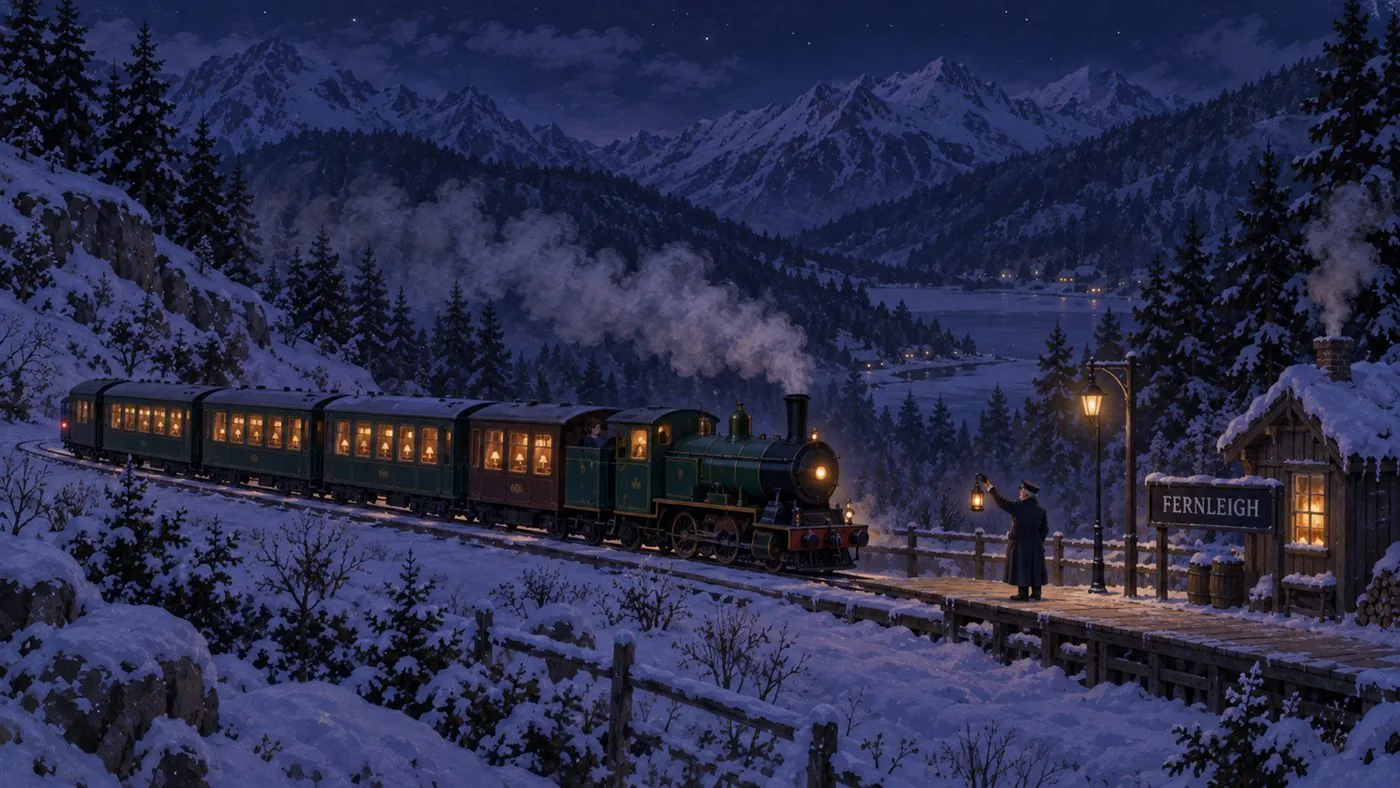
| Where | An old mountain railway, from the city to a lake town, through forests and high valleys |
| When | Midwinter. Evening through the night. |
| Weather | Steady, soft snowfall, with a brief break for a half moon |
| In Lalai | Free, all of it, with no trial, card or account |
Like every Lalai story, it is read slowly in a low voice, over a painted scene that moves softly and dims as the story goes on. Nothing goes wrong and nobody is in a hurry, so there is nothing to follow and nothing to remember.
Who is in it
- Walter The conductor. Tall, quiet, kind, thirty years on the line.
- Mrs. Fenwick The engine driver. Calm and steady. Awake all night so nobody else needs to be.
- Rosa The cook in the dining car. Makes barley soup and cocoa.
- The passengers A family with sleepy twins in red hats, an old gentleman with a violin, two elderly sisters who play cards, a young woman with a book of maps, and a farmer with a large, calm grey dog.
How the hour goes
The story moves through five parts. Each is a little slower and quieter than the one before, and the last drifts off with long rests and no goodbye.
- 0–7 min Departure
- 7–23 min The Carriages
- 23–41 min Up Through the Mountains
- 41–51 min The Conductor's Van
- 51–57 min Drift
The sounds under the voice
Real recordings play under the words, and you choose the balance: more voice, more ambience or even. When the story ends, its sounds can carry on for a few minutes, half an hour or all night.
- The inside of a steam train carriage, wheels on the rails, from the moment it pulls away to the end
- Soft winter air from the snowy station onward
- The iron stove in the conductor’s van, close and low
Read the opening
The first 1000 words, exactly as they are read. The story goes on for about 49 minutes more.
There is a railway line that runs up into the mountains, where the snow comes early and stays long, and on that line, every night of the winter, there runs a small, slow train. It leaves the city in the blue of the evening, and climbs all night through the forests and the high valleys, and comes down in the morning to a town beside a frozen lake, where the houses are painted in soft colours, and the smoke goes straight up from the chimneys into the still, cold air.
It is not a fast train. There are faster trains, on other lines, that go through tunnels and over new bridges and arrive in the middle of the night. This one goes the old way, around the mountains instead of through them, and takes the whole night to do it, and stops at every small station along the way, even the ones where nobody ever gets on or off. The people who ride it like it that way. That is why they choose it.
This is the story of one night on that train, in the middle of winter, and of its conductor, a tall, quiet man named Walter, who had worked on the line for thirty years, and knew every curve of the rails, and every station, and every stationmaster, and most of the stationmasters' cats.
The evening began, as it always did, at the old station in the city, under the great arched roof of iron and glass. Snow was falling beyond the arches, big, soft, slow flakes, drifting down through the light of the station lamps and melting on the platform stones. The train stood waiting at the far platform, painted a deep green with gold lines along its sides, and a thin plume of steam rose lazily from its engine into the cold air.
There were five carriages. At the front, behind the engine, was the dining car, with its little tables and white cloths and brass lamps. Then came two sleeping cars, with their narrow corridors and their rows of small wooden compartments, each with its own door and its own window and its own two bunks, one above the other. Then the lounge car, with deep armchairs and a small stove. And last of all, at the very back, the conductor's van, which was Walter's.
Walter stood on the platform beside the train, in his long navy coat with brass buttons, and his peaked cap, and his thick grey gloves, with a lamp in one hand and his ticket punch in the other. He had a long, kind, weathered face, and grey eyebrows that were usually a little raised, as though everything he saw were mildly and pleasantly interesting. He had all the time the evening needed. The train would leave when everyone was aboard, and not a moment before.
The passengers came along the platform in ones and twos, their breath clouding in the cold. A mother and a father with two small children in matching red hats, who were twins, and very sleepy already. An old gentleman with a white moustache and a violin case under his arm. Two elderly sisters in fur hats, arm in arm, who rode the train every winter to visit their cousin at the lake. A young woman with a large, worn book of maps. And a farmer in a sheepskin coat, with an enormous, shaggy grey dog, who walked beside him very calmly, like a small, patient bear.
Walter greeted each of them, and looked at their tickets, and punched a small, neat hole in each one, and helped them up the steps with their bags. When the last of them was aboard, he walked the length of the train one more time, looking at each door to see that it was closed, and then he stood back, and lifted his lamp, and swung it slowly, twice, toward the engine.
Up at the front, in the warm, glowing cab of the engine, Mrs. Fenwick, the driver, saw the lamp and lifted her hand. She had driven the night train for twenty-two years, and she drove it the way some people knit, calmly, and without seeming to think about it at all. She eased the great brass lever forward, and the engine gave a long, low, soft sigh of steam, and then another, and the whistle sounded, two low, gentle notes, like someone humming the start of a lullaby.
Walter stepped up into his van at the back, and closed the door, and the train began to move. Very slowly at first, so slowly that the platform lamps seemed to be drifting away, rather than the train leaving them. The carriages creaked, and settled, and the wheels began their soft, steady rhythm on the rails. The great glass arches of the station slid back and away, and then the train was out in the open, in the falling snow, and the night had begun.
The conductor's van was a small, square room at the very back of the train, and Walter had made it very comfortable over the years. There was a little iron stove in one corner, with a chimney that went up through the roof, and a kettle on top. There was a narrow desk with a green-shaded lamp, and a logbook, and a pen. There was an old armchair, worn soft, with a tartan rug folded over the back. And at the very back, there was a wide window, which looked out over the rails, running away behind the train into the dark.
He hung his lamp on its hook, and fed a few more lumps of coal into the stove, and set the kettle on the hottest part, and then he took off his gloves, and held his hands out to the stove for a little while, until the warmth had come back into his fingers. Then he put his gloves in his pocket, and picked up his ticket punch and his lamp again, and set out along the train.
Listen to all of it tonight, free. The Night Train is free in Lalai for good, with no trial, card or account. Lalai has no ads, no account and no analytics.

From After Hours
More sleep stories
-
 The Tea House in the Rain
High on a mountain in the rainy season, a woman washes the cups, checks each tea tin and watches the clouds come down the copper rain chain.
-
 The Observatory on Mallow Hill
Hazel opens the dome above a sleeping village, shares soup and Saturn with the baker’s grandson, and closes up as the first snow drifts in.
-
 The Houseboat on the Slow River
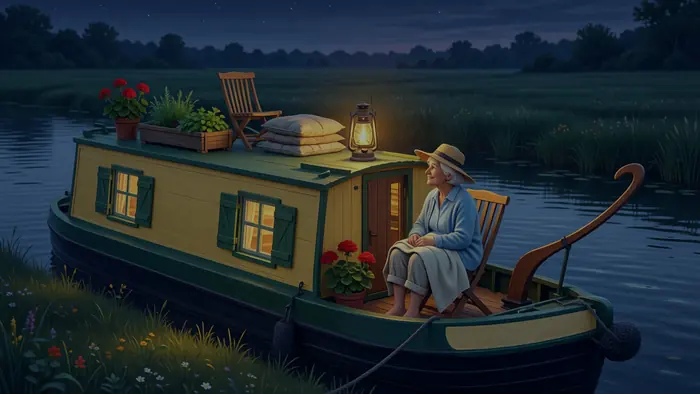
Down a wide, slow river, gently through an old lock, past meadows and a mill, to moor beneath an oak while glow-worms light the bank.
-
 The Winter Glasshouse
Watering bench by bench, banking the boiler, counting the sleeping plants, while snow falls on the glass overhead and turns, late on, to soft rain.
-
 The Caravanserai on the Salt Road
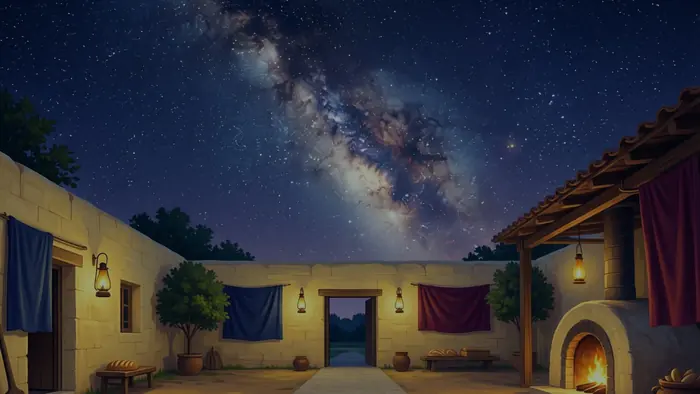
The keeper fills his twelve lamps and bakes bread for whoever the road brings, and everyone carries a mattress up to a roof still warm from the sun.
-
 The Summer Farm on Bell Mountain
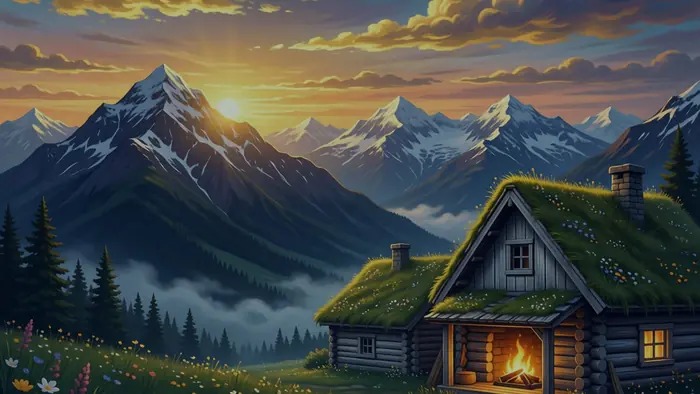
Eight cows brought in and milked by hand, whey stirred over a slow fire, and a box bed under a turf roof with the brook running past the door.