

About the story
| Length | 58 minutes, then about three minutes of the story’s own sounds |
|---|---|
| Where | A small wooden tea house on a shoulder of a mountain, above terraced tea gardens |
| When | The rainy season, early summer. Late afternoon into night. |
| Weather | Fine, steady mountain rain, with clouds settling as the evening cools |
| In Lalai | Included with a subscription, and in the 7 free nights for new subscribers |
Like every Lalai story, it is read slowly in a low voice, over a painted scene that moves softly and dims as the story goes on. Nothing goes wrong and nobody is in a hurry, so there is nothing to follow and nothing to remember.
Who is in it
- Hana Keeper of the tea house. Small, grey-haired, careful and content.
- Plum A large, soft grey cat with white feet.
- Mr. Pell A beekeeper from the cottage with the blue door just below the terraces. Comes up for one cup every rainy evening.
How the hour goes
The story moves through five parts. Each is a little slower and quieter than the one before, and the last drifts off with long rests and no goodbye.
- 0–7 min The Last Walkers
- 7–23 min Closing Up
- 23–40 min The Cloud Comes Down
- 40–50 min Night in the Tea House
- 50–56 min Drift
The sounds under the voice
Real recordings play under the words, and you choose the balance: more voice, more ambience or even. When the story ends, its sounds can carry on for a few minutes, half an hour or all night.
- Fine rain on the tea terraces, heard from under the eaves
- The copper rain chain, dripping cup to cup
- A charcoal brazier, from lighting it until its lid goes on
- Frogs singing on the terraces in the mist
- Rain on the tiled roof, heard from inside through wood and paper
Read the opening
The first 1000 words, exactly as they are read. The story goes on for about 50 minutes more.
High in the mountains, where the road gives up and becomes a path, and the path gives up and becomes a long, winding stair of worn stone steps, there is a tea house. It sits on a flat shoulder of the mountain, among terraces of tea bushes that step down the slopes in green, curving rows, like ripples spreading out from a stone dropped into a still, green pond.
The tea house is small and old and made of dark wood, with a roof of grey clay tiles that curls up gently at the corners, and a wide veranda on three sides, where people sit on cushions to drink their tea and look out at the mountains. The walkers who climb the steps say that the view from the veranda is the finest in the whole range. On clear days, it goes on forever. But on rainy days, which are most days in the early summer, the view is mostly cloud, and nobody minds at all.
The tea house is kept by a woman named Hana, and she has kept it for most of her life. This is the story of one evening in the rainy season, when the last of the walkers had gone back down the mountain, and the rain had settled in for the night, and Hana was closing the tea house, the way she did every evening, slowly, and carefully, and in the same order as always.
It had been raining all afternoon. Not hard, but steadily, the fine, soft, patient rain of the mountains, the kind that seems less to fall than to hang in the air, and drift, and settle on everything in tiny silver beads. It beaded on the tea leaves on the terraces. It beaded on the veranda rail. It beaded on the grey fur of the cat, who was sitting at the top of the steps, watching the last walkers go down.
There were three of them, a young couple and an older man with a walking stick, and they went down the stone steps together, slowly, talking quietly, in bright raincoats, yellow and red and blue. They turned at the first bend and waved, and Hana waved back from the veranda. Then they went on round the bend, and the colours of their coats grew soft in the mist, and then they were gone, down toward the village in the valley, where their suppers and their warm beds were waiting.
The cat's name was Plum. She was a large, soft, grey cat with a white chest and white feet, as though she had once walked through a saucer of milk, and she had lived at the tea house for as long as anyone could remember. She took no interest in the walkers when they arrived, and a great deal of interest in them when they left, because it meant the evening had come, and the evening was when the tea house belonged just to her and Hana.
Hana herself was small and straight-backed, with grey hair tied up in a knot and held with a wooden pin, and hands that were steady and careful and always a little warm from holding teapots. She wore a long indigo apron with deep pockets, and soft cloth shoes, and when she walked across the wooden floors of the tea house, she made almost no sound at all.
She stood on the veranda for a while after the walkers had gone, with her hands folded in her apron, breathing the air. It smelled of rain, and wet stone, and green tea leaves, and somewhere underneath it all, the faint, sweet smell of the pine woods higher up the mountain. Below her, the terraces stepped down into the cloud. Above her, the peaks had disappeared into it. The whole world had become soft and grey and quiet, and very close.
From the corner of the roof, where the gutters met, a rain chain hung down to the ground. It was a long chain of little copper cups, one below another, each one green with age, and the rain ran down it from cup to cup, filling each one and spilling over into the next, all the way down to a round stone basin at the bottom. It made a small, bright, trickling sound, like someone pouring tea very slowly from a great height, and it never stopped, all through the rainy season.
Hana listened to it for a moment. Cup, to cup, to cup. Then she took her broom from its hook by the door, and began.
First, she swept the veranda. The broom was made of long, dry grasses bound to a bamboo handle, and it made a soft, whispering sound on the dark boards, like the sound of the rain itself. She swept slowly, from the inside wall toward the edge, one long stroke after another, and the few fallen leaves and small bits of grit slid ahead of the broom, and off the edge of the veranda, and into the wet garden below.
She swept the front of the veranda, where the view was, and then along the side, past the rain chain, and then around the back, where the little kitchen was, and the woodpile, and the door to the small room where she slept. Plum followed her a few steps behind, and sat down whenever she stopped, and got up whenever she moved on, as though the sweeping could not properly be done without her.
Next, she gathered the cushions. There were twelve of them, set out along the veranda for the walkers to sit on, and they were flat and square and covered in faded blue cloth, and some of them had been mended so many times that they were more mending than cushion. Hana picked them up one at a time, and shook each one gently, and tapped the rain from it, and stacked them in a soft blue tower just inside the door, where they would stay dry until morning.
Listen tonight, free for 7 nights. New subscribers get seven nights free, then $24 a year or $3 a month. The Night Train is free for good. Lalai has no ads, no account and no analytics.

From After Hours
More sleep stories
-
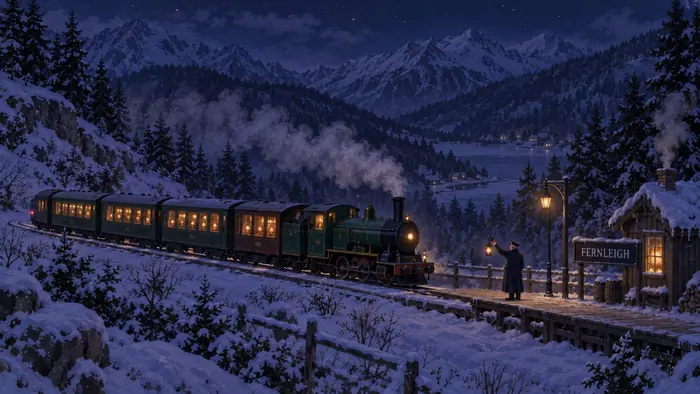 Free
The Night Train Through the Snow
A small, slow steam train climbs all night through snowy mountain forests, and the conductor turns the lamps down carriage by carriage as the passengers fall asleep.
-
 The Observatory on Mallow Hill
Hazel opens the dome above a sleeping village, shares soup and Saturn with the baker’s grandson, and closes up as the first snow drifts in.
-
 The Houseboat on the Slow River
Down a wide, slow river, gently through an old lock, past meadows and a mill, to moor beneath an oak while glow-worms light the bank.
-
 The Winter Glasshouse
Watering bench by bench, banking the boiler, counting the sleeping plants, while snow falls on the glass overhead and turns, late on, to soft rain.
-
 The Caravanserai on the Salt Road
The keeper fills his twelve lamps and bakes bread for whoever the road brings, and everyone carries a mattress up to a roof still warm from the sun.
-
 The Summer Farm on Bell Mountain
Eight cows brought in and milked by hand, whey stirred over a slow fire, and a box bed under a turf roof with the brook running past the door.