
About the story
| Length | 61 minutes, then about three minutes of the story’s own sounds |
|---|---|
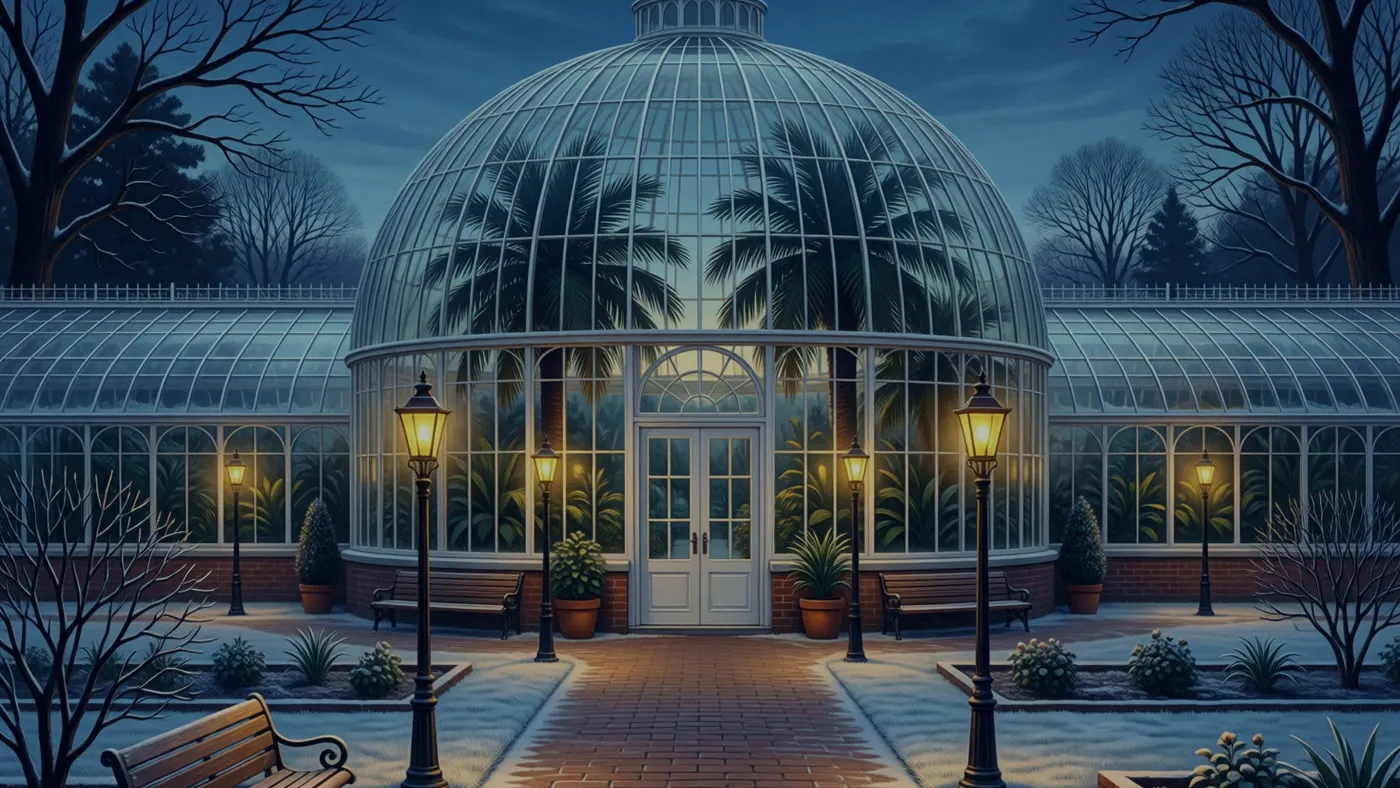
| Where | The great curved glasshouse at Larkfield Botanic Garden, and the small warm potting room attached to its boiler house |
| When | Deep winter. A short winter afternoon into a long night. |
| Weather | Hard frost, then falling snow, turning late in the evening to a soft, steady rain on the glass |
| In Lalai | Included with a subscription, and in the 7 free nights for new subscribers |
Like every Lalai story, it is read slowly in a low voice, over a painted scene that moves softly and dims as the story goes on. Nothing goes wrong and nobody is in a hurry, so there is nothing to follow and nothing to remember.
Who is in it
- Nell The glasshouse's night gardener, about sixty-five. Thirty winters in the same warm green room, and she knows every plant in it by name.
- Rosa The young gardener who works the day and cycles home across the park at dusk with a lamp on her handlebars.
- Marmalade An old tortoise who sleeps all winter in a wooden box of oak leaves under the tree ferns.
How the hour goes
The story moves through five parts. Each is a little slower and quieter than the one before, and the last drifts off with long rests and no goodbye.
- 0–7 min The Early Dark
- 7–24 min The Evening Round
- 24–43 min Snow on the Glass
- 43–52 min The Potting Room
- 52–58 min Drift
The sounds under the voice
Real recordings play under the words, and you choose the balance: more voice, more ambience or even. When the story ends, its sounds can carry on for a few minutes, half an hour or all night.
- The low, warm hum of the boiler, heard through a wall
- Slow drips falling into a still tank of water
- Soft, steady rain on a glass roof, heard from inside
Read the opening
The first 1100 words, exactly as they are read. The story goes on for about 52 minutes more.
There is a garden in the middle of an old city, and in the middle of that garden there is a glasshouse, very large and very old, shaped like a great curved bubble of glass and white-painted iron. In the summer it is one green room among many. In the winter, when the beds outside are bare and the paths are hard with frost, it is the only warm place for miles, and everything living in the garden seems to lean toward it, the way people lean toward a fire.
Inside, it is the middle of a different country. The air is warm and damp and smells of wet brick and green leaves and, faintly, of lemons. Palms go up out of the dark and spread their hands against the roof. Ferns unroll along the benches. Somewhere, water is dripping slowly into a tank. And along the whole length of the glasshouse, under the benches, the iron heating pipes lie warm as loaves, ticking quietly to themselves all night long.
The person who looks after it at night is a woman named Nell. She is about sixty-five, small and square and slow-moving, with grey hair cut straight across, and she has been the night gardener at Larkfield for thirty winters. She knows every plant in the glasshouse by name, and roughly how it is feeling. This is the story of one evening in the deepest part of one winter, the kind of evening when the dark comes down early and the glass turns black at four o'clock and the whole building becomes a lamp.
The day had been bright and hard and very cold. All afternoon the frost had stayed on the lawns in the shadow of the hedges, in long blue-white shapes, and the ponds had held their ice, and the few visitors who came had walked quickly with their chins down in their collars. By half past three the light was already going, thinning from gold to grey to a soft, ordinary dark, and the birds had stopped in the trees, and the garden began, very slowly, to empty itself.
Rosa, the young gardener who worked the day, was the last to leave. She wheeled her bicycle up the main path with her collar turned up and her breath going before her in clouds, and stopped at the glasshouse door and put her head in, and the warm air came out around her and turned at once to mist. “All watered on the bench by the door,” she said. “And the big fern has a new frond.” Nell said she had seen it, and Rosa smiled, and pulled the door to behind her, gently, the way everybody there pulled it.
Nell stood at the glass and watched her go. The little lamp on the handlebars made a small wobbling circle of light on the path, and it went along past the bare rose beds, and over the bridge, and through the gate at the far end, and out into the streets beyond, where it joined all the other lights and became one of them. Then Nell reached up and set the door on its catch, and the glasshouse closed around her, warm and green and entirely her own for the next twelve hours.
It is a particular kind of quiet, the quiet of a glasshouse at night. There is no wind in it. Nothing moves except what she moves herself. Underneath everything is the low, steady, contented hum of the boiler in its brick house at the end, so constant that she only ever heard it when it stopped, and above that, very faint, the small sounds of water: a drip into the lily tank, a bead of condensation running down a pane, the slow soak of wet earth settling in a pot.
The glasshouse was longer than a street. From where she stood she could see the whole length of it: the brick path running away between the benches, the great palms rising in the middle where the roof lifted highest, the iron staircase spiralling up to the walkway, and at the far end, small and yellow, the one lamp she left burning over the potting room door. Everything else was shadow and leaf, and the black glass above.
She went along and turned on the low lamps, one after another, the way she did every evening: the one by the door, the one over the fern bench, the one above the lily tank, the one at the foot of the palms. They were old and warm and yellow and threw more shadow than light, which was the idea. Anything brighter would have made the plants think it was still afternoon, and, as Nell said, everyone in here had earned their night.
Then she hung her thick coat on the nail inside the potting room door and put the kettle on the little stove, and stood a moment with her cold hands over it, turning them, palm and back, palm and back, until the ache of the outside went out of them. She had three things to do before the night was hers. The watering. The boiler. The leaves to wipe. And after that, nothing at all, which was the best part of the day.
She did the boiler first, because everything else depended on it. The boiler lived in a brick lean-to at the end of the glasshouse, with a black iron door and a little grille in it that glowed a soft orange, like a cat's eye. When she pulled the door open, the heat came out and pressed on her face and her forearms, and the fire inside was a low, deep, red bed with blue at the edges, quiet as breathing, nothing leaping about, exactly as a fire should be at this hour.
She fed it slowly, a shovelful at a time, spreading each one flat and letting it settle before the next. There was no sense filling it high. A slow fire, evenly laid, would hold its heat all night and still be there in the morning, a bed of grey ash with red in the middle of it. When it was laid to her liking she closed the door most of the way, and set the damper, and the boiler drew, and hummed, and went on with its long, even breath.
Listen tonight, free for 7 nights. New subscribers get seven nights free, then $24 a year or $3 a month. The Night Train is free for good. Lalai has no ads, no account and no analytics.

From After Hours
More sleep stories
-
 Free
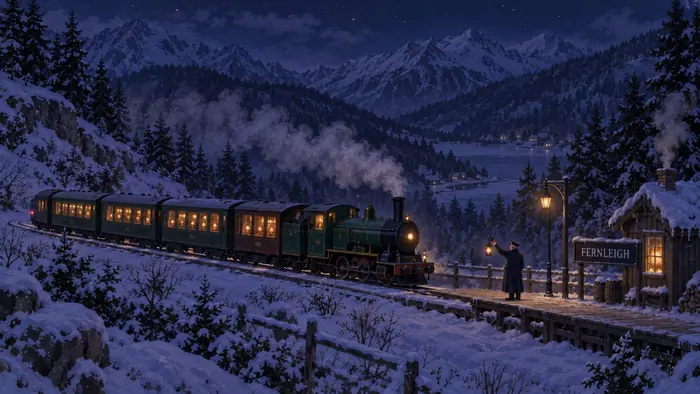
The Night Train Through the Snow
A small, slow steam train climbs all night through snowy mountain forests, and the conductor turns the lamps down carriage by carriage as the passengers fall asleep.
-
 The Tea House in the Rain
High on a mountain in the rainy season, a woman washes the cups, checks each tea tin and watches the clouds come down the copper rain chain.
-
 The Observatory on Mallow Hill
Hazel opens the dome above a sleeping village, shares soup and Saturn with the baker’s grandson, and closes up as the first snow drifts in.
-
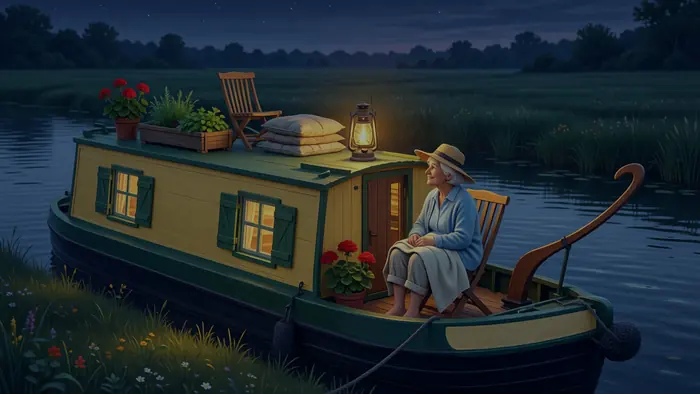 The Houseboat on the Slow River
Down a wide, slow river, gently through an old lock, past meadows and a mill, to moor beneath an oak while glow-worms light the bank.
-
 The Caravanserai on the Salt Road
The keeper fills his twelve lamps and bakes bread for whoever the road brings, and everyone carries a mattress up to a roof still warm from the sun.
-
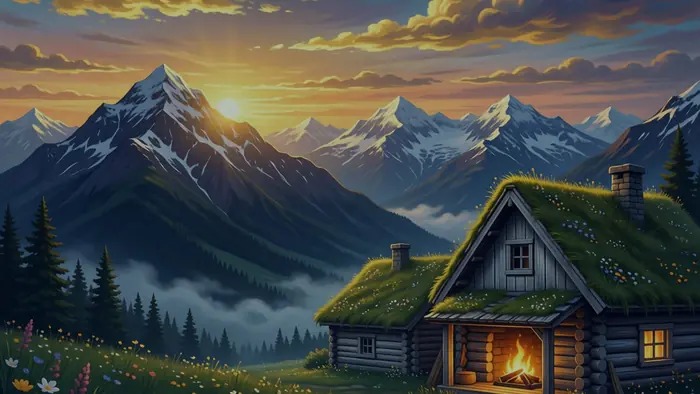 The Summer Farm on Bell Mountain
Eight cows brought in and milked by hand, whey stirred over a slow fire, and a box bed under a turf roof with the brook running past the door.