
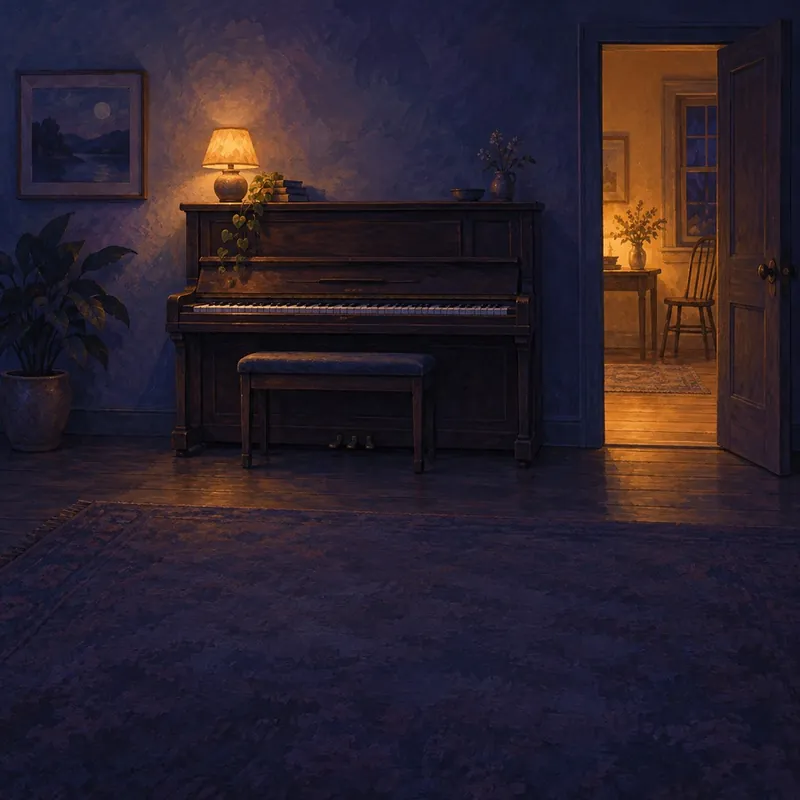
Every piece in the family
All 8, slowest first. They run between 40 and 60 beats a minute. Pieces marked free play in the app without a subscription.
| Piece | Key | Tempo | Length |
|---|---|---|---|
| Kankyō, 1984Japanese environmental music: soft bells and glass tones for an empty gallery. | C Major | 40 bpm | 2:38 |
| OndesOne early-electronic voice sliding between the notes on a slow vibrato. | E Minor | 44 bpm | 2:38 |
| Piano, window openSparse playing with the weather and the room left in the recording. | G Minor | 46 bpm | 2:38 |
| Mellotron flutesTape flutes wobbling warmly through chords that take their time. | F Major | 48 bpm | 2:38 |
| Piano through a wall (free)Somebody playing in the next room, and the room itself. | Ab Major | 48 bpm | 2:38 |
| Library, 1972A faded orchestral cue for a quiet scene — strings, harp and alto flute. | Eb Major | 56 bpm | 2:26 |
| Wurlitzer hazeElectric piano reeds gone soft, chords left hanging in the room. | Bb Major | 56 bpm | 2:38 |
| Berlin, slowAn analogue sequence turning over and over under warm pads. | E Minor | 60 bpm | 2:38 |
The instruments
Most of these pieces are heard from a distance: a piano in the next room, an electric piano softened until its chords hang in the air, old electronics with the hiss left on. Distance takes the edge off the attack of each note and adds the sound of the room.
Kankyō ongaku, Japanese for environmental music, was a style of the 1980s written for real spaces such as galleries, shops and homes, meant to sit in the background. The Mellotron is a 1960s keyboard in which every key plays a strip of recorded tape, which gives its flutes and strings their warm wobble. The Wurlitzer electric piano strikes metal reeds and picks them up electrically. The ondes Martenot, invented in France in 1928, is one of the first electronic instruments, played by sliding a ring along a wire.
How it’s made
Lalai’s music is generated with an AI music model on our own machines, then chosen, levelled and looped for the app. There are no session musicians: the instruments named here describe what each piece sounds like. Every piece is a seamless loop, so it can play all night on its own, under a story or under a mix of night sounds.
The length shown is one pass of the loop. In the app it repeats until the timer ends, with no join you can hear.
All 64 pieces, all night. In the Lalai app every piece plays as a seamless loop with the screen off, on its own or under a story or a mix of night sounds, with its own level and a sleep timer. Six pieces are free for good; the rest come with a subscription, $24 a year or $3 a month, with seven nights free.

The other families
- Bowed strings. Fiddles, cellos and psalteries, slow enough to hear the rosin.
- Plucked strings. Silk, gut and steel, picked once and left to fall away.
- Hammers and mallets. Struck wood and wire, felted until the notes overlap.
- Flutes and breath. Bamboo, reed and pipe, with the breath left in.
- Reeds and bellows. Squeezeboxes and drone boxes, breathing on their own time.
- Voices. Wordless singing in stone rooms and on old tape.
- Drones and bowls. One long tone, or something close to it.
- Chamber, late. Two or three players, a lot of space, nobody in a hurry.
For music under a sound rather than on its own, try it with night sounds like rain or a fire.