
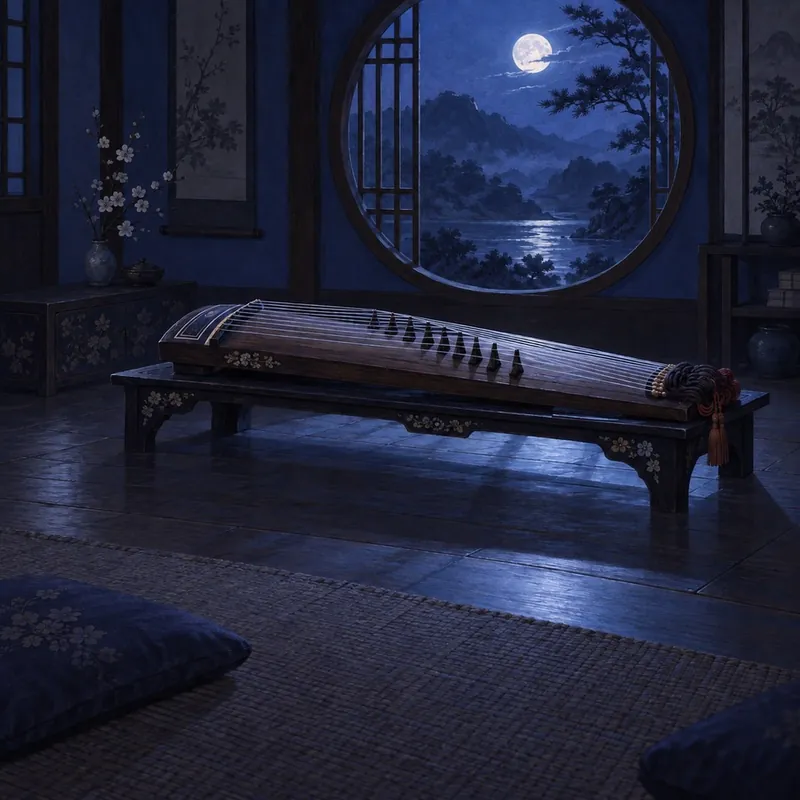
Every piece in the family
All 13, slowest first. They run between 38 and 54 beats a minute. Pieces marked free play in the app without a subscription.
| Piece | Key | Tempo | Length |
|---|---|---|---|
| Biwa, sparseStruck with a wooden plectrum and then left completely alone. | C Minor | 38 bpm | 1:40 |
| Gayageum moon (free)Korean silk strings plucked and pushed into long bends, with long silences after. | E Minor | 44 bpm | 2:24 |
| Prepared guitarAn acoustic guitar with things laid on the strings: muted, metallic, sparse. | C Minor | 44 bpm | 2:38 |
| Sarod at midnightPlucked on a fretless steel plate, so every note slides into the next one. | D Major | 44 bpm | 2:38 |
| Setar, very quietA small Persian lute played with one fingernail, as if to nobody. | C# Minor | 44 bpm | 2:38 |
| Theorbo at nightLong bass lute strings plucked bare by candlelight and allowed to decay. | F Major | 44 bpm | 2:38 |
| Dan tranh riverVietnamese steel strings shaken into a wide vibrato behind the bridge. | F# Minor | 48 bpm | 2:26 |
| Alpine zitherAn old-fashioned waltz, plucked softly and kept just off the beat. | G Major | 50 bpm | 2:38 |
| Dulcimer on the porchA noter sliding along the melody string while two drones keep ringing. | D Major | 50 bpm | 2:38 |
| Kanun taksimSeventy Turkish strings rippling, then stopping to think about it. | D Minor | 50 bpm | 2:38 |
| Qanun, CairoCascades of plucked notes and then long pauses in a carpeted room. | F Minor | 50 bpm | 2:26 |
| Autoharp quiltChords brushed so gently that they arrive as one warm sound. | C Major | 52 bpm | 2:38 |
| Krar in the eveningSix gut strings turning one slow cycle over and over in a dark courtyard. | E Minor | 54 bpm | 2:38 |
The instruments
A plucked note starts at its loudest and dies away, so slow plucked music is made as much of the silence after each note as of the notes. These pieces leave plenty of it.
Most of the world’s zithers and lutes are here. The gayageum is a Korean zither of twelve silk strings on movable bridges, bent by pressing the string on the far side of the bridge. The kanun, or qanun, is a trapezoidal zither of the Middle East with small levers to retune each course by fractions of a tone. The đàn tranh is its Vietnamese cousin. The biwa is a Japanese lute struck with a large wooden plectrum; the theorbo a Baroque lute with a long neck carrying extra bass strings; the sarod a fretless North Indian lute on a polished metal fingerboard, so every note can slide. The setar’s name means “three strings” in Persian, though most now have four.
How it’s made
Lalai’s music is generated with an AI music model on our own machines, then chosen, levelled and looped for the app. There are no session musicians: the instruments named here describe what each piece sounds like. Every piece is a seamless loop, so it can play all night on its own, under a story or under a mix of night sounds.
The length shown is one pass of the loop. In the app it repeats until the timer ends, with no join you can hear.
All 64 pieces, all night. In the Lalai app every piece plays as a seamless loop with the screen off, on its own or under a story or a mix of night sounds, with its own level and a sleep timer. Six pieces are free for good; the rest come with a subscription, $24 a year or $3 a month, with seven nights free.

The other families
- Bowed strings. Fiddles, cellos and psalteries, slow enough to hear the rosin.
- Hammers and mallets. Struck wood and wire, felted until the notes overlap.
- Flutes and breath. Bamboo, reed and pipe, with the breath left in.
- Reeds and bellows. Squeezeboxes and drone boxes, breathing on their own time.
- Voices. Wordless singing in stone rooms and on old tape.
- Drones and bowls. One long tone, or something close to it.
- Keys and tape. Pianos, tape flutes and old electronics, from another room.
- Chamber, late. Two or three players, a lot of space, nobody in a hurry.
For music under a sound rather than on its own, try it with night sounds like rain or a fire.