About the recording
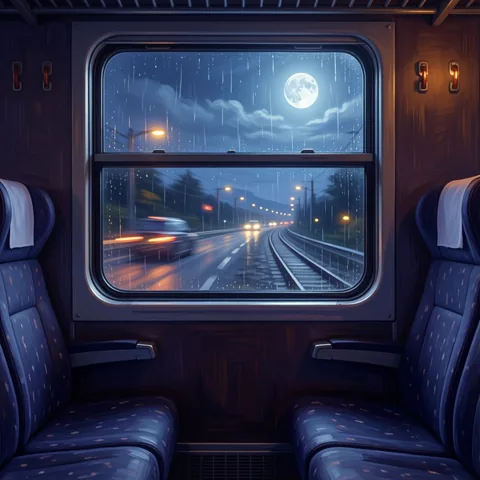
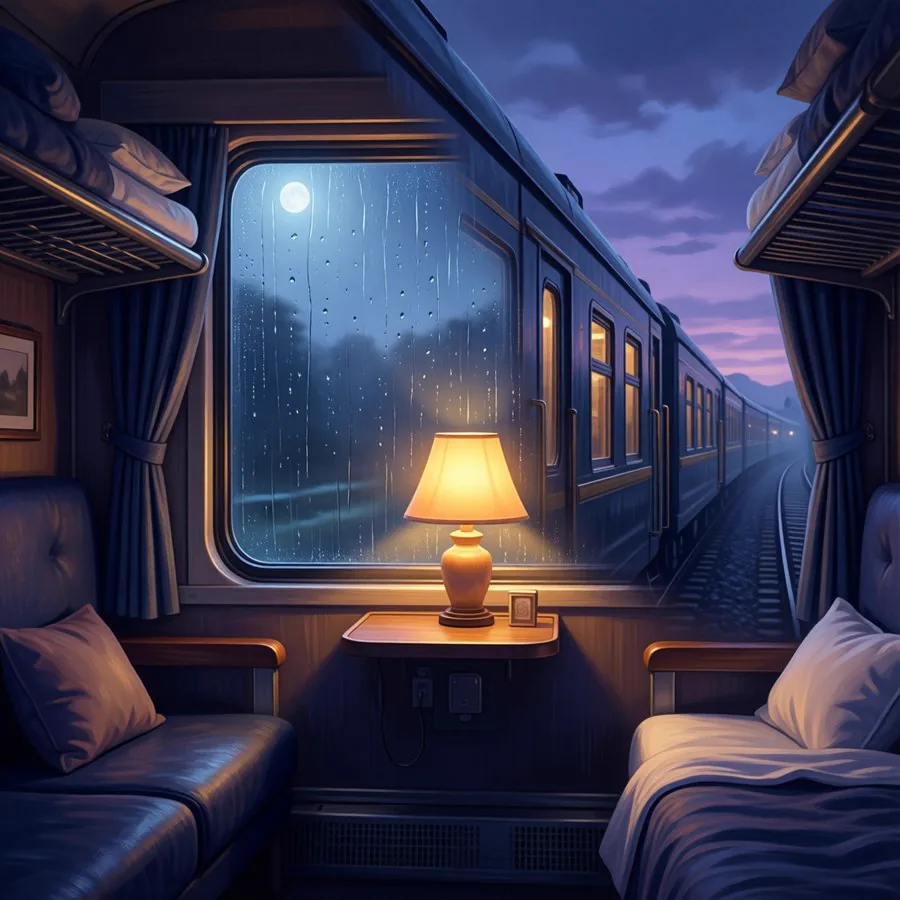
So0N recorded it inside an ICE, Germany’s high-speed intercity train. It is one of the deepest recordings on the site, with its energy centred around 100 Hz: more a rumble you feel than a sound you follow.
Its level moves by about four decibels, because a train is never quite still: the track curves, the carriage sways, and tunnels and cuttings come and go outside.
Why a modern train doesn’t go clickety-clack
The old clickety-clack came from rail joints. Track used to be laid in short lengths with a small gap between them to allow for expansion, and every wheel clicked over every gap. On a carriage with four axles, those clicks came in a familiar pattern.
Most main lines now use continuously welded rail, joined into lengths of a kilometre or more and held under tension so it can’t buckle in the heat. With no gaps, the click is gone, and what is left is the smooth rumble of steel wheels on steel rail.
High-speed trains add air. The faster a train goes, the more of the noise comes from air rushing over the carriage and through the gaps between cars, which is why fast trains are built with smooth noses and sealed gangways.
Measured
We measured the loop on this page. Its energy peaks in the octave around 63 Hz, and its spectral centroid, the balance point of all its energy, is 104 Hz: brighter than 3 of the other 49 sounds on this site. Between its quieter and louder moments there are about 4.1 decibels, so it moves noticeably, and it is steadier than 3 of the others.
The numbers
| Octave band | A night train |
|---|---|
| 63 Hz | 0 dB |
| 125 Hz | -8.2 dB |
| 250 Hz | -8.9 dB |
| 500 Hz | -12 dB |
| 1 kHz | -21.6 dB |
| 2 kHz | -30.2 dB |
| 4 kHz | -38.9 dB |
| 8 kHz | -39.3 dB |
| 16 kHz | -40.5 dB |
Closest in shape on this site: just under the surface, the passenger seat and singing bowl drone.
Pair it with
In the app you can layer up to five sounds and set each one’s level, and on this site the mixer does the same with up to five of these. These go well with a night train:
- Rain on a window. Rain streaking past the carriage window.
- Brown noise. A deeper bed under the rumble.
- Snow falling. Snow outside, as on the night train.
Ready-made mixes with it: train in the rain.
In Lalai’s sleep stories
Lalai’s hour-long stories have their own sounds under the voice. You’ll hear this kind of sound in:
- The Night Train Through the Snow: the sleeper carriage, the snow and the long night through the mountains
Questions
Is this a sleeper train?
It is an intercity express, recorded by So0N, which the app uses for its night-train sound. Sleeper carriages are usually slower, but the steady rumble of welded rail is much the same.
From the journal
All night, with the screen off
A browser tab usually stops playing when your phone locks or the tab goes to sleep. In the Lalai app, the full 4-minute recording keeps playing with the screen off and fades out on the timer. You can layer up to five sounds, put slow original music underneath, and keep everything on your phone for nights with no signal.
A night train is free in Lalai. No trial, no card and no account: it’s one of the free sounds, alongside the mixer and the sleep timer. No ads, no account, no analytics.

Listening safely
Start with your volume low, keep the phone off the pillow, and let the timer fade the sound out. Our listening notes say more.
Lalai is for relaxation and enjoyment. We don’t claim that this or any sound changes how you sleep, and if poor sleep goes on for weeks, please see a doctor. More on protecting your hearing.
More journeys and rooms
All 6 journeys and rooms compared, and in winter sounds, sounds for noisy neighbours. Or browse all 50 night sounds.